Structural Drying and Dehumidification in Lakewood, CA
Water moves into shared walls, floors and neighboring units, and Lakewood has 1,051 attached homes plus 378 units in two-to-four-unit buildings. The crew sets air movers, dehumidifiers and mats by measured need and keeps them running until readings are dry.
(888) 563-9619Set up the drying equipment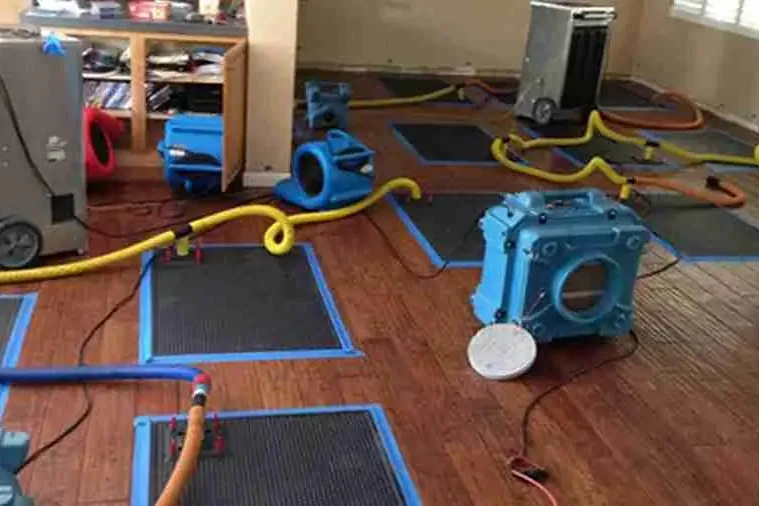
First steps for structural drying and dehumidification
Stop the source
The leak must be fixed or shut off before drying can work.
Remove standing water
Extraction comes before any equipment is set.
Keep doors closed
Closed rooms let dehumidifiers work efficiently.
Leave equipment on
Running units dry the structure, and stopping early leaves moisture behind.
Drying is physics, not guesswork. Air movers lift moisture off surfaces, dehumidifiers pull it from the air, and meters show whether the framing, drywall and flooring are actually giving it up.
What does structural drying and dehumidification cost in Lakewood, CA?
Drying runs $1,500 to $3,000 for class 1 or 2, $3,000 to $6,000 for class 3, and $6,000 to $9,000 for class 4 floors.
| Job size | Typical range | What it covers |
|---|---|---|
| Class 1 or 2 loss | $1,500 to $3,000 |
|
| Class 3 loss | $3,000 to $6,000 |
|
| Class 4 slab or hardwood | $6,000 to $9,000 |
|
These are typical ranges, never a quote. Four things move the total most: the water category, the wet square footage, the material class and how soon drying began. The water damage cost calculator narrows it for your own loss.
How structural drying and dehumidification is handled, stage by stage
Moisture gets mapped with meters and a thermal camera before a single fan is set, so the plan follows the readings and not the stains. The drying team pulls equipment only when materials test dry.
- I
Measure
Meters and a thermal camera set the starting readings.
- II
Place
Air movers, dehumidifiers and mats go where the readings call for them.
- III
Monitor
Temperature, humidity and moisture content are logged each visit.
- IV
Release
Equipment leaves only after every material reaches dry values.
Choosing the right equipment
Class 1 and 2 jobs need fewer units, while class 3 and 4 jobs with saturated walls, ceilings or dense floors need more power and sometimes desiccant drying. The crew sizes equipment from measured moisture and room volume.
- Airflow aimed across wet walls and floors
- LGR dehumidifiers matched to room size
- Drying mats for dense or sealed floors
- Desiccant units for the deepest moisture
Placement matters as much as quantity, because air has to cross every wet surface and the dehumidifier has to see the humid air. Closed doors, opened wall cavities and lifted baseboards all help the equipment reach moisture the surface hides.
Shared walls and attached homes
Attached homes and apartment buildings share walls, so a wet wall can belong to two households. Drying plans cover adjoining surfaces and are documented for every affected unit.
Daily monitoring
Each visit records temperature, humidity and moisture content, which shows whether the structure is drying or stalling. Equipment is moved or added when a reading lags, and it only comes out once every material meets the dry standard. Water extraction and slab leak water damage jobs both end with this stage.
Structural drying and dehumidification across Lakewood and nearby cities
Drying equipment goes into homes across ZIP 90712, 90713 and 90715, from the Del Amo Boulevard and Carson Street areas to Mayfair, Imperial Estates, Cherry Cove and the apartment buildings near South Street.
The same service nearby: structural drying and dehumidification in Cypress, Artesia, Hawaiian Gardens.
Related water damage services

Structural Drying and Dehumidification questions, answered
Why can drying equipment stay for days?
Moisture inside framing and flooring leaves slowly, and the equipment stays until readings show every material is dry.
What does LGR mean?
Low grain refrigerant dehumidifiers pull moisture out of air even when humidity is already fairly low, which speeds drying.
Is the noise normal?
Yes, air movers and dehumidifiers are loud, but they are the reason a structure can dry in days instead of weeks.
Can a slab or hardwood floor dry in place?
Sometimes, with drying mats or desiccant units, but dense materials dry slowly and are monitored longer.
Does drying raise the electric bill?
The equipment draws power while it runs, and the crew keeps the number of units no higher than the readings justify.
How is a finished job confirmed?
Moisture readings in each material fall to the dry standard, and the logs show the trend from the first visit to the last.
Let the readings decide when it is dry
Surface-dry is not dry. The restoration team places measured equipment, checks it every visit and removes it only when framing and floors meet the standard.
(888) 563-9619Plan the dry-out