Structural Drying in La Palma, CA
Wet framing, drywall and subfloors keep holding water after the visible puddles are gone. The crew sets air movers, LGR dehumidifiers and drying mats by the moisture map and logs readings until La Palma materials reach dry.
(888) 563-9619Call to start the dry-out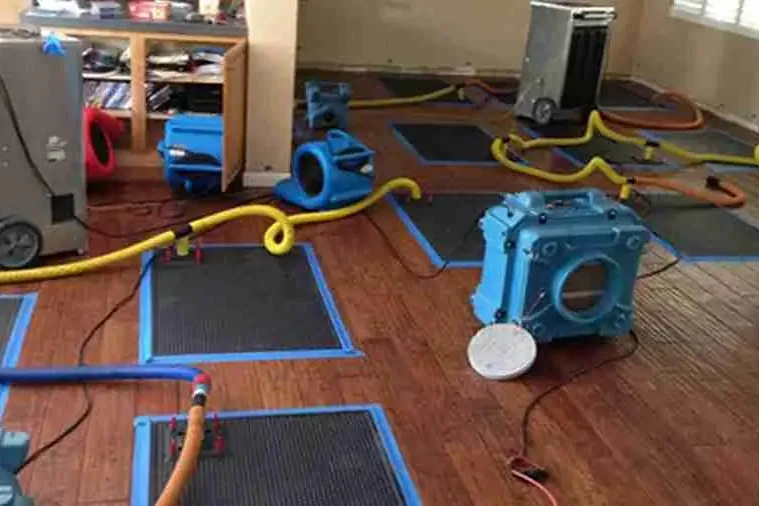
First steps for structural drying and dehumidification
Leave equipment on
Once drying equipment is running, keep it on and do not move it.
Close doors and windows
Keep the area closed so the dehumidifiers work efficiently.
Stay off wet floors
Foot traffic can push moisture deeper into carpet and boards.
Log what you see
Note new stains or smells and mention them at the next visit.
La Palma has 469 single-family attached homes and 861 units in buildings of five or more units, so moisture often has shared walls to follow. Structural drying treats the building as one system, not just the room where the water landed.
What does structural drying and dehumidification cost in La Palma, CA?
One area usually runs $1,500 to $3,000, several rooms run $3,000 to $6,000, and slab or hardwood drying can reach $9,000.
| Job size | Typical range | What it covers |
|---|---|---|
| Class 1 or 2, one area | $1,500 to $3,000 |
|
| Class 3 across several rooms | $3,000 to $6,000 |
|
| Class 4 slab or hardwood | $6,000 to $9,000 |
|
These are typical ranges, never a quote. Four things move the total most: the water category, the wet square footage, the material class and how soon drying began. The water damage cost calculator narrows it for your own loss.
How structural drying and dehumidification is handled, stage by stage
Moisture gets mapped with meters and a thermal camera before a single fan is set, so the plan follows the readings and not the stains. The drying team pulls equipment only when materials test dry.
- I
Map
Meters and a thermal camera set the wet boundary before equipment goes in.
- II
Place
Air movers, dehumidifiers and mats go where the map shows moisture.
- III
Monitor
Temperature, humidity and moisture content are read every visit.
- IV
Release
Equipment leaves only after every wet point reads dry.
How the drying plan is built
Drying starts from the loss class, which describes how much water the materials have absorbed, and from the water category, which describes how clean it was. Together they decide how many air movers and dehumidifiers go in. Standing water leaves through water extraction before equipment goes in.
- LGR dehumidifiers condense moisture out of the air
- Air movers sweep dry air over damp surfaces
- Drying mats draw water from hardwood and subfloors
- Desiccant units handle dense concrete
Cavities, walls and shared surfaces
Small holes drilled at the base of a wall let warm dry air flow through the cavity, so the wall can dry without being torn out. Where the wall is shared, the readings continue along it.
Equipment is never pulled on a calendar date: it leaves only when the last wet point reads dry, because stopping early leaves moisture inside the walls.
Daily monitoring
Each visit the crew measures temperature, humidity and moisture content, moves or removes equipment that is no longer needed and records the numbers. The drying time estimator gives a rough idea of the schedule before any readings exist.
Structural drying and dehumidification across La Palma and nearby cities
The crew serves ZIP 90623, from the single-family streets near Moody Street and Walker Street to the apartment buildings and attached homes around Central Park, the Civic Center and the Centerpointe business area.
The same service nearby: structural drying and dehumidification in Cypress, Cerritos, Hawaiian Gardens.
Related water damage services
Structural Drying and Dehumidification questions, answered
What is the difference between drying and just using fans?
Fans move air, but dehumidifiers pull water out of it, and without both the moisture simply moves from one surface to another.
What do the four loss classes mean?
Class 1 and 2 are smaller or less absorbent losses, Class 3 means water came from above and soaked ceilings and walls, and Class 4 covers dense materials such as concrete and hardwood.
Can wet walls dry without being torn out?
Often yes. Small holes at the base of the wall or removed baseboards let dry air move through the cavity, and meters confirm when the framing and drywall are dry.
How do readings show that a building is dry?
The crew compares each wet material with a dry reference reading from an unaffected area of the same material, and equipment stays until the numbers match.
Does drying in an attached home affect the neighbor?
Moisture can follow shared walls, so readings continue along them, and the other household is told what the readings show so it can check its own side.
Moisture left inside a wall keeps doing damage
Describe the loss, the materials involved and any shared walls, and the crew will explain the equipment and monitoring a dry-out would need.
(888) 563-9619Describe the loss