Structural Drying in Cerritos, CA
After the water is out, the drying team places air movers, LGR dehumidifiers and mats where meters show moisture, then records temperature, humidity and material readings each visit until framing, subfloors and slabs return to dry targets.
(888) 563-9619Plan a drying setup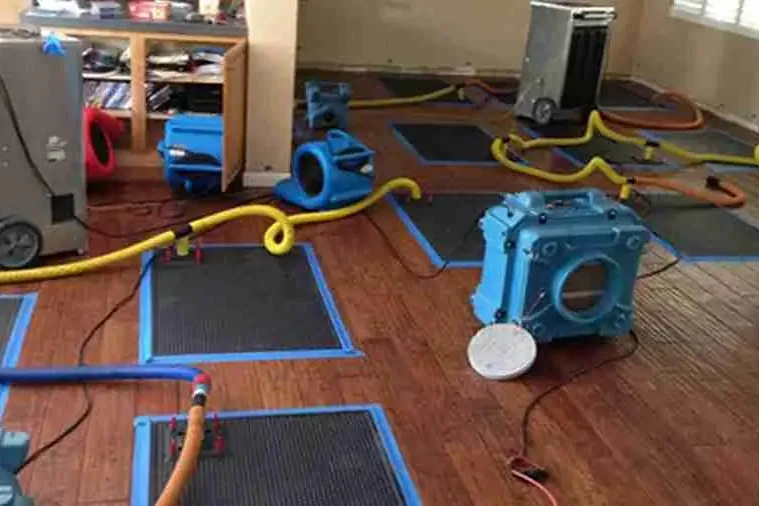
First steps for structural drying and dehumidification
Stop the source
Make sure the leak is repaired or the supply is closed.
Leave equipment alone
Do not move or switch off running drying gear.
Keep doors closed
Close wet rooms so the dehumidifier controls the air.
Review the readings
Ask the technician to explain each visit's numbers.
Drying is a measured process, not a matter of running fans until the room feels better. Materials are dry when readings match a reference, not when the surface is warm or the carpet stops squishing.
What does structural drying and dehumidification cost in Cerritos, CA?
Structural drying runs $1,500 to $3,000 for one wet area, $3,000 to $6,000 for several rooms, and $6,000 to $9,000 for slabs or hardwood that need desiccant units.
| Job size | Typical range | What it covers |
|---|---|---|
| Class 1 or 2, one area | $1,500 to $3,000 |
|
| Class 3, several rooms | $3,000 to $6,000 |
|
| Class 4: slab or hardwood | $6,000 to $9,000 |
|
These are typical ranges, never a quote. Four things move the total most: the water category, the wet square footage, the material class and how soon drying began. The water damage cost calculator narrows it for your own loss.
How structural drying and dehumidification is handled, stage by stage
Moisture gets mapped with meters and a thermal camera before a single fan is set, so the plan follows the readings and not the stains. The drying team pulls equipment only when materials test dry.
- I
Map
Meters and humidity readings set the starting point for each room.
- II
Place
Air movers, LGR units and mats go where moisture is highest.
- III
Monitor
Readings are logged each visit and the setup is adjusted.
- IV
Release
Equipment leaves once every material reaches its dry target.
A mild climate still needs control
The area has a Mediterranean climate with rain mostly in winter and warm to hot summers. Indoor humidity changes with the season, which is why dehumidifiers are matched to the room and the readings, not to the weather outside. Most homes date to the 1960s and 1970s and construction details vary, so the team checks what sits behind the drywall and under the flooring before choosing a drying method.
How the equipment works together
Air movers push dry air across wet surfaces, LGR dehumidifiers pull moisture from the air, and mats draw water out of floors, the same approach used after slab leak water damage.
- Air movers sized to wall and floor area
- LGR dehumidifiers for steady humidity control
- Drying mats and desiccant units for hardwood and concrete
- Cavity drying through small openings
How the team knows it is done
Each visit the technician records readings at the same marked points, adjusts the equipment and compares them to a dry reference. Water extraction comes before drying, and the log becomes part of the claim file.
Structural drying and dehumidification across Cerritos and nearby cities
Drying crews work throughout ZIP 90703, including homes along Bloomfield Avenue, Studebaker Road, Pioneer Boulevard, Artesia Boulevard and Alondra Boulevard, and the multi-unit buildings, shops and offices around the Civic Center area.
The same service nearby: structural drying and dehumidification in Cypress, Artesia, La Palma.
Related water damage services
Structural Drying and Dehumidification questions, answered
How long does structural drying take?
It depends on the materials, the amount of water and the humidity. Carpet and drywall often dry faster than hardwood, framing or concrete, and the readings decide the end date.
Why is the equipment so loud and large?
Air movers and LGR dehumidifiers are sized to the wet volume, so a few strong units dry faster than many weak ones. The noise is the cost of controlled drying.
Can I turn off the equipment at night?
It should keep running, because stopping it lets moisture settle back into materials. If noise is a problem, tell the technician so the placement can be adjusted.
What do the daily readings show?
They show whether moisture is dropping in each material and whether the air stays dry enough to keep pulling water out, which tells the team when to move or remove gear.
Why does hardwood or slab drying cost more?
Dense materials hold water longer and need desiccant units, mats and extended monitoring, which raises equipment time and labor.
Get the structure dry and documented
A call sets the equipment count, the placement and the reading schedule so wet materials reach target without guesswork.
(888) 563-9619Plan the dry-out