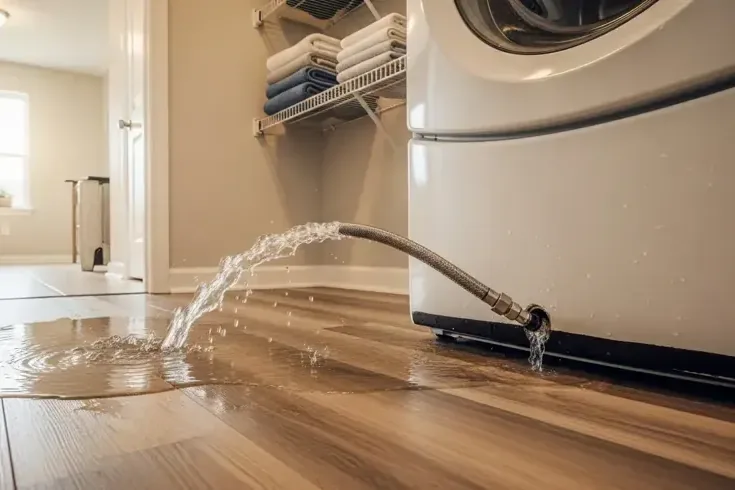
A washer hose that splits or a dishwasher that leaks can soak a kitchen floor in an apartment, and the water rarely stops at the front door. In Hawaiian Gardens, where 834 units sit in buildings of five or more units, a single appliance can send water into a neighbor's ceiling.
Key takeaways
- Washer, dishwasher and refrigerator supply hoses are common starting points for leaks in multi unit buildings.
- The city has 834 units in buildings of five or more units, 364 in buildings of two to four units and 527 attached single family homes.
- Shutting off the water at the appliance and telling the property manager right away limits the spread.
- Water can travel through floors, walls and light fixtures into the unit below.
- Both units need moisture readings, because the wet area often reaches past the visible stain.
Why appliance leaks spread in multi unit buildings
Much of the housing here shares walls, floors or ceilings. When water gets out of an appliance, it has more places to go than it would in a detached house.
An attached home shares a wall with another household, and in a stacked building the ceiling of one unit is the floor of the next. Water crosses those boundaries more easily than it seems.
The average household has 4.1 people, so appliances run often and hoses and fittings work hard. The mix of housing is listed here.
- 834 units in buildings of five or more units.
- 364 units in buildings of two to four units.
- 527 attached single family homes.
- An average household of 4.1 people.
Where appliance leaks start
Washing machines
A washer has two supply hoses and a drain hose, and any of them can split, loosen or slip off a fitting. An overflowing drain pipe behind the machine can also spill water onto the floor.
Hoses are the weak point in most laundry leaks, and a hose that has bulged or cracked is already close to failure.
- Cracked or bulging supply hoses.
- Loose hose connections at the wall valves.
- A drain hose that slips out of its standpipe.
- A clogged drain that backs up and overflows.
Dishwashers and refrigerators
Dishwashers leak at the supply connection, the drain hose or the door seal. Refrigerators with ice makers and water dispensers leak at the thin supply tubing behind the unit.
- Water under the dishwasher or the kitchen cabinets.
- Warped flooring in front of the dishwasher.
- Damp or discolored cabinet bases.
- A wet floor behind the refrigerator.
First steps for a tenant
A quick response limits the damage to the unit and to the neighbors. The steps below take only a few minutes and make every later step easier.
Acting before the water spreads is the single most useful step. Even a few towels at the base of a wall can keep a small leak from reaching the next unit.
- Turn off the water at the appliance valve, or at the shutoff for the unit.
- Unplug the appliance if it is safe to reach.
- Mop or vacuum standing water and move rugs and boxes.
- Photograph the damage and the source.
- Tell the property manager in writing right away.
- Ask neighbors below to check their ceilings and walls.
How water reaches the unit below
Water finds the lowest path. It can pass through gaps around pipes, seams in the floor, light fixtures and wall cavities.
A ceiling stain in the unit below may show up long after the first leak. By then the cavity above it can be soaked, and a ceiling leak water damage job often starts with that cavity.
In a building of five or more units, the unit below may not be the only one affected. Water can travel sideways along a ceiling cavity and show up in the next unit over.
- Stains or bubbles on the ceiling.
- Water dripping from a light fixture.
- Wet baseboards on a shared wall.
- Paint that blisters or peels.
Drying shared walls and floors
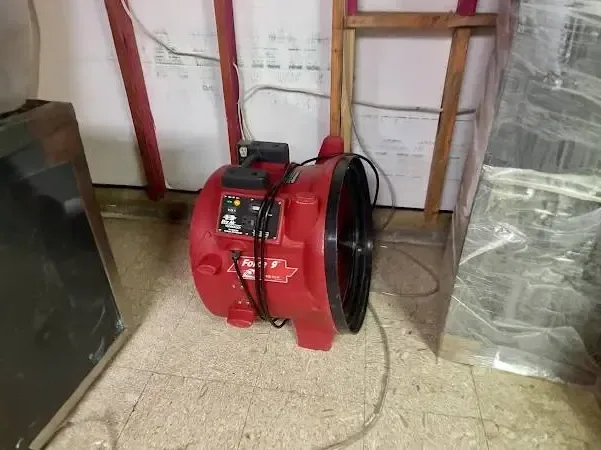
Structural drying in a multi unit building covers both units. Moisture meters and a thermal camera show where the water went, and equipment goes into each wet space.
Cabinet bases, flooring and wall bottoms are checked first. Appliance leak cleanup ends on dry readings in both units, not on how things look.
Drywall, insulation and cabinet bases that stay wet are replaced rather than dried, and the plan is shared with the property manager before work begins.
- Readings taken in the source unit and the unit below.
- Wet insulation and drywall removed where needed.
- Air movers and dehumidifiers in both spaces.
- Equipment moved as the readings improve.
Mistakes that make appliance leaks worse
Small errors in the first day can double the damage. Most come from waiting or from guessing that a wet spot will dry on its own.
- Waiting a day to see whether the floor dries.
- Running a fan on a wet wall without checking behind it.
- Skipping photographs before moving belongings.
- Ignoring a neighbor who reports a stain below.
- Pulling up carpet without telling the property manager.
Renters, owners and property managers
The 2010 Census counted 55.7 percent of occupied homes as rented, and the 2018 homeownership rate was 41.4 percent. Many households therefore deal with a landlord or a property manager during a loss.
Leases usually spell out who handles walls, ceilings and appliances, so the lease is worth a read. Prompt written notice and clear photographs keep the process smooth.
In attached single family homes, a shared wall can carry water from one household to the next. Both households should be told early, so drying can cover both sides of the wall.
- Written notice to the property manager.
- Photographs with dates.
- A list of damaged belongings.
- A record of calls and messages.
Questions
Who is responsible for a washer leak in an apartment?
It depends on the lease and on whose appliance it is. The property manager is the first call, and the water still has to be cleaned up right away.
Can a leak in one unit damage a neighbor?
Yes. Water passes through floors, walls and light fixtures, and the unit below often sees it first.
Why are both units checked for moisture?
Water that stained one ceiling may also be inside the walls and floor of the unit above. Readings in both units show the full wet area.
Should a damp cabinet base be replaced?
Cabinet bases made of particleboard swell and rarely recover. Solid wood can often be dried, and readings decide which is which.
How quickly should an appliance leak be reported?
As soon as it is found. A quick report lets the property manager call the cleanup crew before the water spreads further.
What if the leak came from an appliance the tenant does not own?
The property manager is told right away, and the water is still extracted and dried. Responsibility for the repair is sorted out after the building is safe.